
You bought the form everyone recommends. You take it before bed. You still wake up at 3:00, or lie there wondering whether it did anything at all.
The word “magnesium” on the front of the bottle does not tell you why the product failed to change your sleep.
The form, the elemental amount, and the rest of the formula all change what you are taking. Your last hour before bed affects how you sleep too.
Make these seven checks before you spend money on another bottle.
See how Mellow’s label addresses the magnesium-form question →
1. You may not know which form of magnesium you are taking

Turn the bottle around. The small print may say oxide, citrate, glycinate, bisglycinate, malate, or L-threonate. Each is magnesium joined to a different compound.
The compound changes how much elemental magnesium fits in a serving and how the product sits in your stomach. Each form also has its own body of research.
The NIH reports that several soluble forms generally show better bioavailability than oxide and sulfate. That finding is about how the body absorbs magnesium. It is not proof that one form improves sleep.
L-threonate is the form behind the “brain magnesium” conversation. Human sleep research exists, but it is newer and narrower than social media posts often suggest.
When the front says “magnesium for sleep,” turn the bottle over and find the form.
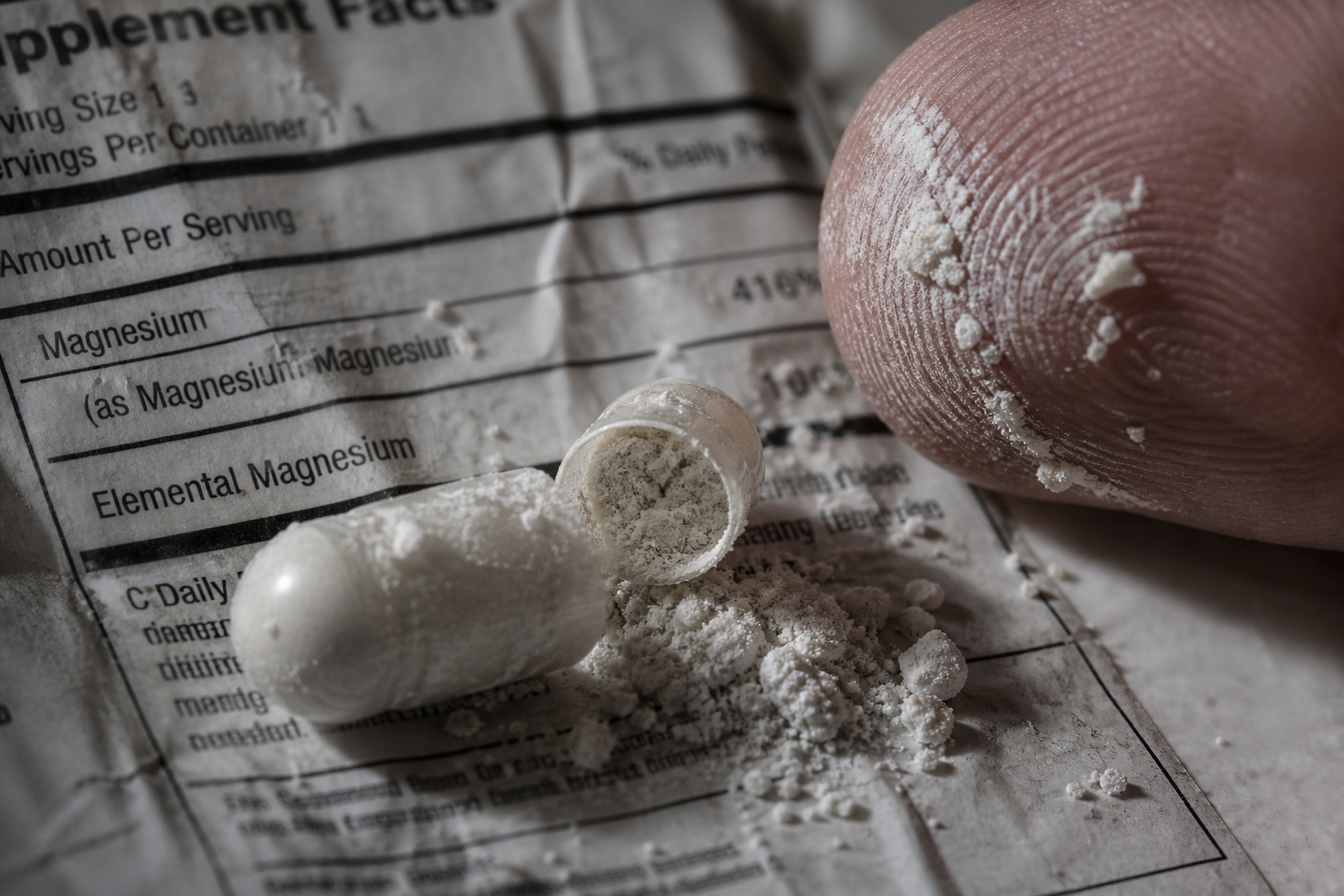
Check the Supplement Facts panel. What form is actually in it?
2. The big dose on the front may include less magnesium than you think

A bottle can advertise a large amount of a magnesium compound while supplying a much smaller amount of elemental magnesium.
Elemental magnesium is the amount of magnesium itself. That is the number used when comparing the serving with dietary recommendations and supplement limits.
This is why two products can put very different numbers on the front and still deliver similar elemental amounts. It is also why taking more scoops based on the biggest number can be a bad idea.
Look for wording such as “Magnesium 100 mg” in the Supplement Facts panel. Then read the parenthetical form beside it.
If you cannot find the elemental amount and form on the panel, ask the brand before buying.
Compare elemental magnesium, not the largest milligram number on the package.
3. A well-absorbed magnesium form may still do nothing for sleep

Many magnesium pages treat absorption as proof of better sleep.
A form can be absorbed well and still lack strong evidence for improving sleep. Absorption answers whether magnesium reaches the body. A sleep trial asks whether people fell asleep faster, stayed asleep longer, or felt better the next day.
A product can answer the absorption question without answering the sleep question.
Reviews of magnesium and sleep have found promising signals, but the evidence is mixed. The reported sleep change depends on who took the magnesium, which form and dose they took, and how the researchers measured sleep. A product page should not turn that into a guarantee that one capsule will fix insomnia.
Look for the exact form and amount, then check what the human study measured.
If a claim moves from “absorbed” to “better sleep” without showing a human sleep study, slow down.
How Mellow’s label addresses the form question
Mellow’s label lists magnesium glycinate and magnesium L-threonate together with L-theanine in a 2.7 gram calming blend.
The serving identifies both magnesium forms. The label does not promise that the combination will change everyone’s sleep.
See how the complete evening formula fits together →
What a recent magnesium sleep trial found
A 2025 randomized, double-blind, placebo-controlled trial followed 155 adults with self-reported poor sleep for four weeks. One group took magnesium bisglycinate and the other took placebo.
Both groups improved. The magnesium group improved a little more on the main insomnia score. That additional improvement was statistically significant, but modest.
Magnesium’s additional benefit was modest. A magnesium product may help some people. The trial did not show a dramatic overnight change, and it did not test every magnesium form or every complete sleep formula.
The study also reported a larger response among participants whose magnesium intake was lower at the start. The researchers described that subgroup result as something that needs more study.
WHAT THE TRIAL SHOWEDResearch check: The trial followed 155 people for four weeks and tested magnesium bisglycinate. The benefit over placebo was modest.
4. One small trial tested magnesium L-threonate for sleep for 21 days

Magnesium L-threonate gets attention because early research examined magnesium levels in the brain. A dramatic brain graphic does not show whether people slept better in a human trial.
A 2024 randomized, double-blind, placebo-controlled trial studied 80 adults ages 35 to 55 with self-reported sleep problems. Participants took 1 gram per day of magnesium L-threonate for 21 days.
The study reported improvements in several Oura Ring sleep measures and some next-day measures compared with placebo. Other subjective measures moved in a favorable direction but did not reach statistical significance.
The trial tells you who participated and what dose they took. It also tells you how long the study lasted and which sleep measures changed.
The study was small and recent, and researchers connected to the ingredient supplier participated. It does not prove that L-threonate works for every person or that it outperforms every other form.
Good evidence tells you who took it, how much they took, how long they took it, and which sleep measures changed.
5. More magnesium can cause diarrhea instead of better sleep

When the first serving does nothing, the obvious move is to take more. That can mean stomach cramps, nausea, or diarrhea instead of sleep.
The National Institutes of Health lists 350 mg per day as the upper limit for magnesium from supplements and medications for adults, unless a healthcare professional recommends otherwise. That limit does not include magnesium naturally present in food.
Magnesium can also interact with some medicines. People with kidney problems need particular care because the kidneys clear excess magnesium.
Read the elemental amount before changing the serving. More powder can mean more stomach cramps or diarrhea.
Read the elemental amount and follow the label. Ask a clinician or pharmacist if you take medication or have kidney problems.
If the first serving did not help, doubling it is not a sleep strategy.
6. Late-night work and phone use can keep you awake after taking magnesium

One person takes magnesium after answering work messages in bed. Another mixes it into a warm drink, lowers the lights, leaves the phone outside the bedroom, and repeats the same sequence each night.
The second person has changed the product and the hour before bed, so any sleep change cannot be credited to magnesium alone.
Caffeine late in the day can keep a person awake. So can alcohol, bright light, an inconsistent bedtime, sleep apnea, restless legs, pain, hot flashes, anxious thoughts, or medication effects. Magnesium does not erase them.
A warm drink can mark the point when you stop scrolling and dim the room. Preparing it takes a few minutes and starts the same routine each night.
While the water heats, put down the phone and leave work messages until morning.
If poor sleep is persistent, severe, or comes with loud snoring, gasping, chest pain, or major daytime sleepiness, talk with a healthcare professional instead of adding another supplement.
Judge the product inside a real bedtime routine, not during a normal night of caffeine and phone light.
7. Mellow combines magnesium glycinate and L-threonate in a warm bedtime cocoa

Mellow combines two magnesium forms with the rest of an evening formula.
Mellow is a warm, melatonin-free cocoa made for the last part of the evening. Its label lists a 2.7 gram calming blend with magnesium glycinate, magnesium L-threonate, and L-theanine. A separate 2.3 gram blend lists reishi and ashwagandha. The full ingredient list includes cacao and valerian. Jujube appears separately on the label.
It has zero grams of sugar and 30 servings per pouch. The label shows the weight of each blend, but it does not state the elemental magnesium per serving. That missing number prevents a direct dose comparison with a standard magnesium capsule.
Mellow gives you two listed magnesium forms in a warm drink you can prepare at the same time each night. It does not treat insomnia.
The label separates the serving into two blends. Magnesium glycinate, L-threonate, and L-theanine share the 2.7 gram calming blend.
The 2.3 gram blend contains reishi and ashwagandha, while valerian and jujube appear elsewhere on the ingredient list.
The directions place one warm serving about 30 minutes before bed.
If a generic magnesium capsule did nothing, compare its label with Mellow’s complete formula.
Read the full Mellow label and decide whether the formula fits your night.
Before you buy another magnesium product
Check four things on the back:
- The exact magnesium form or forms.
- The elemental magnesium per serving, or whether the label omits it.
- The evidence for the outcome being promised.
- Every other active ingredient in the serving.
Mellow shows its forms and blend weights, but not the elemental magnesium amount. If you want to see the complete formula, serving directions, current price, and guarantee, continue to the product page.
This is a paid article from Müde. It provides general educational information and does not replace medical advice. Individual responses to dietary supplements vary.