The particle that carries metal into you, and the checkpoint most people never think about
You already filtered your water. This is about what got through before that, and what rides in every day from everywhere else.

July 1, 2026 · 11 min read

Picture a piece of plastic smaller than a grain of flour. You cannot see it. You have almost certainly swallowed some version of it today. Under a microscope its surface is not smooth like the water bottle it came from. It is pitted, cratered, chewed up by sunlight and time. And in those craters, researchers keep finding something they did not expect to see riding along: metal.
Not metal shavings. Metal ions. Lead. Cadmium. Traces of arsenic. Charged atoms that peel off pipes, soil, industrial runoff, and old paint, then drift through the environment looking for something to cling to. A weathered microplastic, it turns out, is close to a perfect landing pad. Its rough, aged surface carries an electrical charge, and metal ions are drawn to charge the way iron filings snap to a magnet.
Scientists have a plain word for the little particle in that scenario. They call it a vector. A carrier. Something that ferries a passenger from one place to another. In a paper published in Frontiers in Public Health in 2025, researchers described how microplastics can adsorb heavy metals onto their surfaces and act as transport for them, moving those metals through water and, potentially, into the bodies that take the water and food in. The plastic is the raft. The metal is the hitchhiker.
Why this is newWe used to sort these threats into different boxes
For a long time the conversation about clean water ran on two tracks that rarely crossed. One track was plastic. You worried about it because of what it is: synthetic, everywhere, building up in oceans and rivers and, more recently, in us. The other track was heavy metals. You worried about those because of what they do inside a body over years of quiet accumulation. Two problems, two headlines, two mental boxes.
The hitchhiker research collapses the boxes into one. It suggests the two problems have been traveling together the whole time, and that the plastic may be doing part of the metal's work for it: concentrating metal ions on its surface, then carrying that concentrated load somewhere a loose metal ion drifting in water might never have reached on its own. A microplastic can hold more metal per surface than the water around it. When you take in the particle, you may be taking in a small, dense parcel of what was stuck to it.
That reframing matters because so much of how we protect ourselves assumes the old, separate boxes. We filter for one thing. We avoid another. We rarely ask what happens when the two arrive as a package deal.

The honest scaleWhat we know, and what is still being mapped
Here is where a responsible report has to slow down, because this is a field where the certainty runs ahead of the evidence in a lot of headlines, and that helps no one.
What researchers have documented is real. Microplastics have been found in human blood. They have been found in lung tissue, in placentas, in the plaque that builds up inside arteries. Separate work has shown that microplastic surfaces can carry adsorbed heavy metals including lead, cadmium, and arsenic. Those are two solid observations sitting next to each other, and the 2025 Frontiers in Public Health paper is part of a growing body of work asking how much the two overlap inside a living body.
What is not settled is the dose that matters, the long-run effect, and how much of the metal riding on a given particle comes loose where it can do harm. Researchers are still mapping that. Anyone who tells you the full story is known is selling you certainty that does not exist yet. The finding is legitimate and worth your attention. It is also unfinished. Both things are true at once, and you deserve to hold them at once.
So let us set the fear down for a moment, because fear on its own is useless. The more useful question is not "how bad is it." It is "where, in all of this, do I have leverage."
The turnYou are not the one who got this wrong
If you are reading this, there is a good chance you already took water seriously once. You installed the filter. You stopped drinking straight from the tap. You read the label on the bottle. You did the thing most people never get around to doing, and you did it because you were paying attention when a lot of people were not.
None of that was wasted. A good filter catches what is in the water at the moment it passes through your kitchen. That is a real line of defense and you were right to build it. But a filter can only work on the water in front of it. It does nothing about what came through before you installed it. It does nothing about the microplastic in the food packaging, the dust on the windowsill, the bottled water you drank at the airport, the takeout container that held your lunch. The filter guards one door. The hitchhikers use every other door in the house.
The filter guards one door. The hitchhikers use every other door in the house.
None of that is a knock on filtering. It means the opposite: you understood the assignment better than most, and the assignment turned out to be bigger than one appliance under the sink. So the question is not whether you did enough. You did more than enough at the front door. The question is what happens after something already walked in.
The checkpointAlmost everything comes in through one narrow gate
Think about the path a hitchhiker takes to get inside you. Most of it does not come through your skin or your lungs. Most of it comes through the thing you do several times a day without thinking: you eat, and you drink. Which means most of what comes in has to pass through your gut first.
The gut is a checkpoint. It is the long, folded border between the outside world and the inside of you, and it is where your body decides what to let across into the bloodstream and what to pass along and out. A great deal of what you swallow never crosses at all. It moves through and leaves. The window where a metal ion is loose, exposed, and still inside the gut, before it either binds to something and rides out or slips across the border, is the one place in this whole story where a person has real leverage.
That is the idea worth sitting with. You cannot un-swallow a particle. You cannot reach into your own tissue. But the gut is a place things pass through, and if something can meet a loose metal ion there and offer it a better place to bind, that ion can leave with it instead of crossing over. This is not a fringe idea. It is the plain chemistry of binders, and it is old.
The Magnet and the Minerals
The mechanismThe Magnet and the Minerals
The animation above is a cartoon of two real things happening in one glass of water, and the name they go by is the Magnet and the Minerals. Take them one at a time, because the honesty is in the detail.
The Magnet. Certain natural minerals have a cage-like crystal structure that carries a mild negative charge. The one at the center of this story is clinoptilolite, a form of zeolite. Chemists describe its framework as a cation exchanger, which is a formal way of saying it holds onto some loosely bound minerals of its own and will swap them for other charged ions that bind to its cage more tightly. Heavy-metal ions such as lead and cadmium happen to bind tighter. So in the gut, the cage trades what it is loosely holding for the metal it prefers, and when the cage passes through and leaves, the swapped-in metal leaves with it. That is the whole trick, and it is an exchange, not magic. It supports the body's own natural detoxification pathways rather than replacing them, and it happens in the gut, not in your cells or your bloodstream. Any claim beyond that is running ahead of what the science supports, and this report will not run ahead of it.
The Minerals. An exchange has two sides, and this is the other half. Fulvic and humic acids are small, highly charged carrier molecules. Their job in this story is the opposite of binding metal for exit: they grab trace minerals and shuttle them into the water and, from there, toward absorption where plain water carries nothing. So the same dropper that offers a cage for the unwanted passenger to bind to also brings the good minerals back in. Metal has a better place to bind and leave. Minerals come in through the door plain water leaves shut. That is the trade, and it is why the mechanism has two names instead of one.
None of that requires you to believe in anything mystical. Cation exchange is textbook chemistry. A binder in the gut is one of the oldest ideas in the field. The 2022 review in Frontiers in Medicine that describes clinoptilolite as a cation exchanger is describing structure and behavior, not a fix for an illness. Keep the claim exactly that size and it holds.
Why the usual answers missAnother filter cannot reach this
The instinct, for a person who already filters, is to reach for a bigger filter. But a filter lives at the tap, and the checkpoint we are talking about lives inside you, past the point any appliance can reach. You cannot plumb a filter into your gut. So the better filter, however good, is answering a different question than the one the hitchhiker research raises.
The other instinct is a broad binder, and here the honesty cuts both ways. Some binders, activated charcoal being the familiar one, work by grabbing a wide range of things at once. That breadth is exactly the problem. A binder that grabs everything grabs the nutrients you want along with anything you do not. It does not tell the difference. The appeal of a cation-exchange cage is that it is selective by its chemistry: it prefers the tighter-binding heavy-metal ions, and the mineral half of the formula is putting good minerals back rather than stripping them out. That is a fairer trade for a body you have to live in every day. This is a point about mechanism, not a knock on any brand, and there is no product being named here except the one below.
What this looks likeTen drops, morning and night
The product built around this idea is called Trace. It is a dietary supplement, not a device and not a drug, and it is worth being plain about what it is and is not so you can decide for yourself.
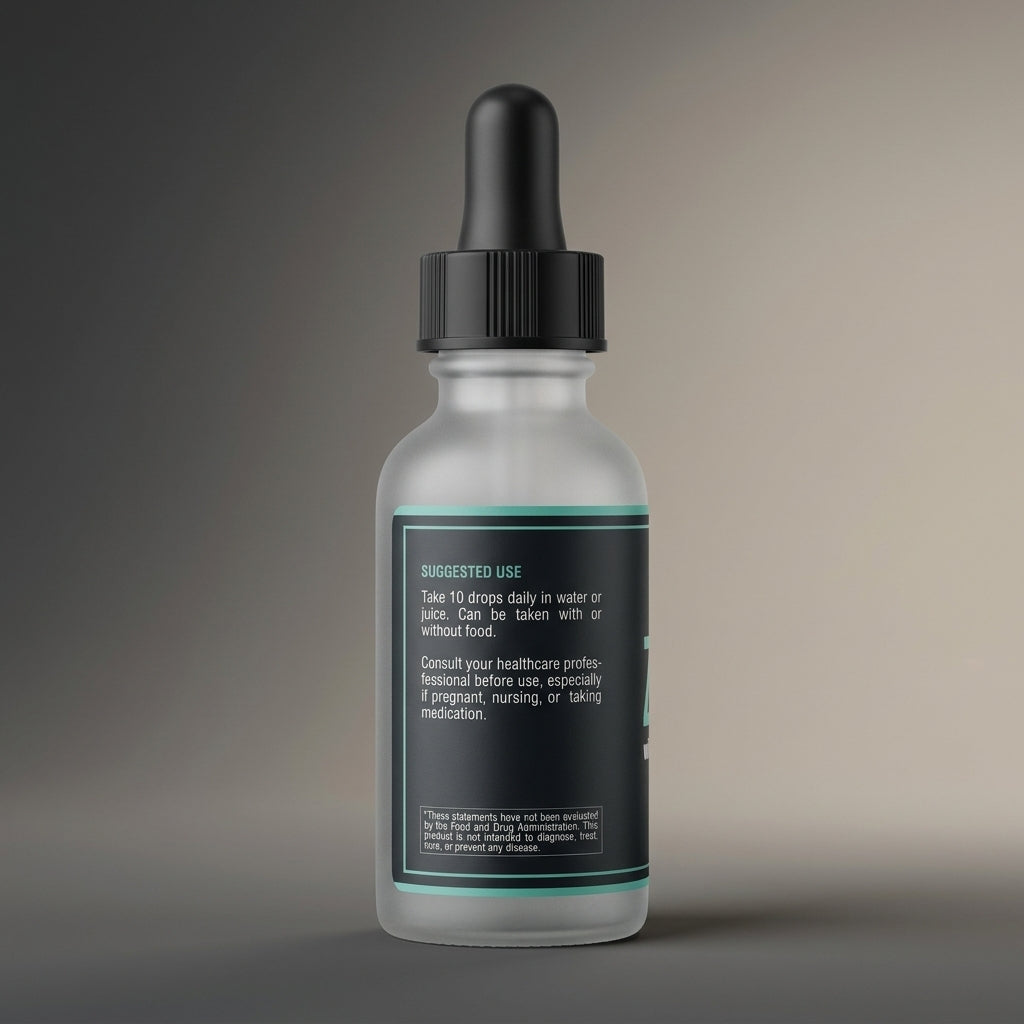
You put ten drops in a glass of water, morning and night. It dissolves clear and the taste is close to nothing, a clean, barely-there note you stop noticing by the second day. One bottle holds a hundred and twenty servings, which at twice a day is a sixty-day supply. There is no ritual to learn and nothing to choke down. You are adding two things to water you were going to drink anyway: a cage for the passenger you would rather not keep, and the minerals to carry back in.
The part that matters most in a category this crowded is the part almost nobody shows you. Purity is this category's dirty secret. Zeolite is a mineral pulled from the ground, and a badly sourced one can carry its own lead or aluminum, which means a product meant to help with metal can quietly be part of the problem. So Trace publishes its third-party heavy-metal panel directly on the product page. You can read the numbers yourself before you decide anything. Lead within spec. Arsenic tested and low against spec. Mercury not detected. Cadmium not detected. A product that asks you to trust it with this specific problem should be willing to show its own test, and this one does. That is the honest version of proof: not a star count, an actual lab result you can look at.
The Magnet: a zeolite cage that swaps its loose minerals for heavier metal ions in the gut, then leaves with them. Cation exchange. It supports the body's natural detoxification pathways.
The Minerals: fulvic and humic carrier molecules that bring trace minerals back into the water plain water leaves out.
Honest expectationsWhat it is fair to hope for
Set the right expectation, because a product that oversells itself has already lied to you once. Trace is not going to announce itself with fireworks. It is a two-a-day habit that works quietly in the background while your gut does the sorting it already does. The people who use drops like these tend to describe small, gradual things over weeks: steadier energy through the afternoon, a lighter feeling, sleep that lands a little deeper, the mental fog thinning at the edges. That vocabulary is soft on purpose. It is what people report, not a promise printed on your future. Some people notice the mineral-and-taste side first and the rest not at all. That is a fine outcome too. The mechanism is doing its quiet trade in the gut whether or not you feel a headline about it.
The skeptic"Detox is a scam"
Good. Hold onto that. The word detox has been stretched over so many pills and patches and foot pads that treating it with suspicion is the correct reflex, and this page is not going to ask you to switch it off.
So read the fine print of the claim. This report is not asking you to believe in detox as a lifestyle or a cleanse or a promise to wash your body clean. It is describing two pieces of ordinary chemistry. One: a cation-exchange cage swaps loosely held minerals for tighter-binding metal ions in the gut, a mechanism written up in the peer-reviewed literature. Two: fulvic and humic acids carry trace minerals in. Both are structure-and-function statements about how a mineral behaves, not a fix for a condition and not a claim to pull metal out of your tissue or your blood. If a page ever tells you a dropper does that, close the page. The honest version is smaller and steadier, and it is the only version worth your money. Your liver and kidneys do the heavy lifting of clearing your body. This is a binder in the gut and minerals back in, working alongside them, not instead of them.

The guaranteeSixty days to feel it or not
Here is the arithmetic that makes trying it low-stakes. One bottle is a sixty-day supply, and Trace comes with a 60-day money-back guarantee. Reply to your order email inside sixty days and you get a full refund, opened bottle or not, with nothing to ship back. That means you can run the whole two-a-day habit for the entire window the way the science suggests it should be run, judge it against your own afternoons and your own sleep, and if it did nothing for you, it costs you nothing. The guarantee is set up to cover the outcome, not the packaging alone. That is the version of a guarantee that respects a skeptic.
The closeYou guarded the front door. This is the hallway.
The hitchhiker finding is unsettling because it turns a familiar problem into a package deal and moves part of it inside a boundary you cannot filter. That is worth sitting with, and it is also worth not spiraling over, because the same story that names the problem points at the one place you still have leverage. Not your bloodstream. Not your tissue. The gut, where things pass through, and where a cage can offer a metal ion a better place to bind while the minerals ride back in.
You already proved you are the kind of person who acts on this stuff when most people scroll past it. You filtered your water. The Magnet and the Minerals is the same instinct, aimed one door further in. It is a glass of water, twice a day, with a published lab panel behind it and sixty days to change your mind.
P.S. If you read one thing before deciding, read the third-party heavy-metal panel on the product page, not the marketing. A company willing to publish its own test on the exact thing it claims to help with has told you more about itself than any headline could. Trace is, at the end of it, a dietary supplement and a small honest trade: a cage for the passenger, and the minerals back in.
These statements have not been evaluated by the Food and Drug Administration. Trace is a dietary supplement, not a drug, and is not intended to diagnose or prevent any illness.
Reader comments
The door metaphor is what got me. I spent real money on the filter and honestly felt like that was the whole job done. Never once thought about the takeout containers and the plane water. Ordered.
I work in a lab and half of me was ready to roll my eyes at another detox thing. Credit where due, they kept it to cation exchange in the gut and did not claim it scrubs your blood. That is the only version I would take seriously.
Not buying it. Your liver already does this. Detox is a marketing word.
Fair pushback, Ray, and you are right that the liver and kidneys do the real clearing. The claim here is narrower than the word detox usually implies: a binder that offers metal ions a place to bind in the gut, plus minerals back in. It works alongside your organs, not instead of them. If a page claims more than that, I would be skeptical too.
Appreciated that they said the science is unfinished instead of pretending it is all locked in. That actually made me trust the rest more, not less.
Taste really is nothing. Two weeks in. Not expecting fireworks, but the afternoon slump has been softer, which is enough for me to keep going through the bottle.