
1945: The Year Drinking Water Changed, and What the Glass Lost
Two announcements came out of one year: the eight-glasses rule and the first fluoridated city. My mother spent sixty years saying city water tastes like nothing. It took the original 1945 documents, one dropped sentence, and a small bottle of drops to prove her right.

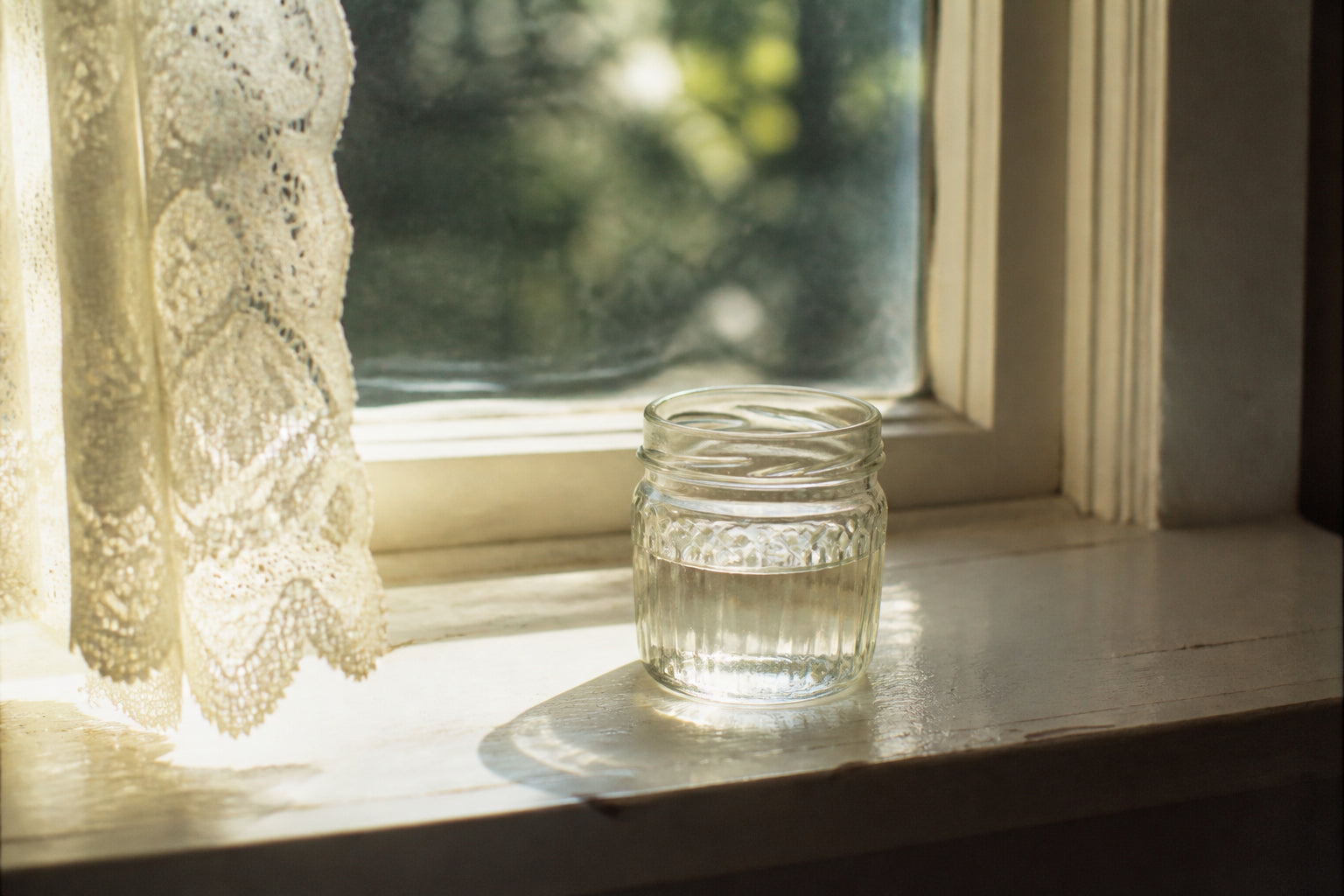
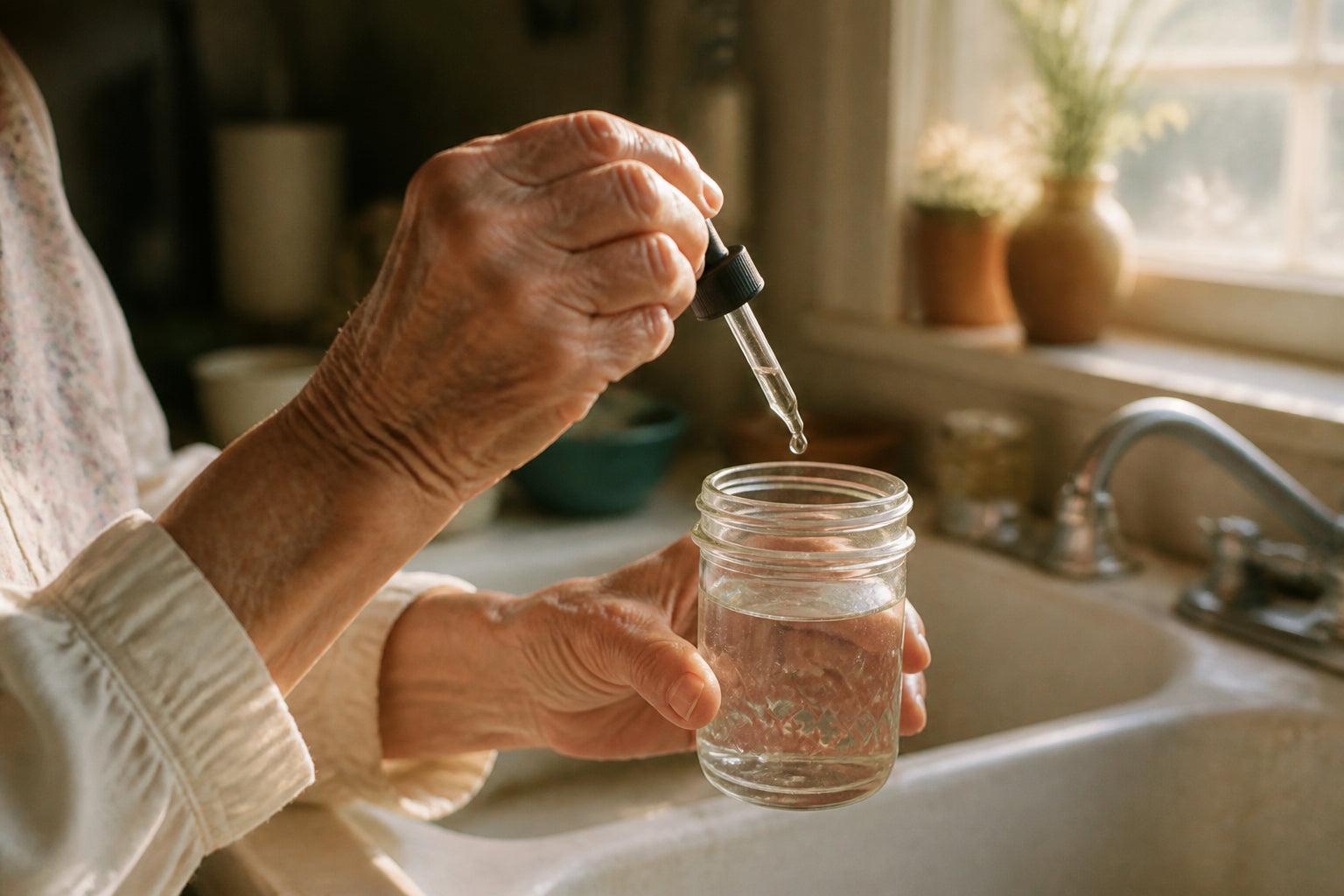
My mother kept a jelly jar on the windowsill above her kitchen sink for fifty years. It was her water glass.
She would fill it from the tap, drink half, make a small face, and set it back down. As a girl I assumed the face was about the jar, which had once held grape jelly and never let you forget it.
It took me most of my adult life, and one long winter of reading, to learn the face was about the water.
She grew up on a farm outside Cassville, Missouri, on well water her father pumped into a bucket each morning. She married in 1961 and moved to town, to a house with copper pipes, good pressure, and a monthly water bill.
For the next sixty years she said the same sentence whenever anyone brought up the old place. “The water there tasted like something. Water here tastes like nothing at all.”
I filed that under homesickness.
Then last January, while we sorted a box of my grandmother's papers, I found a brittle newspaper clipping about drinking water from the 1940s. I got curious about the date on it and started pulling a thread.
The thread led back to a single year: 1945. Two announcements came out of those twelve months. The first put a new ingredient in American water, and the second set the number of glasses the whole country would spend eighty years counting.
The Year Water Changed Hands

On January 25, 1945, engineers at the Monroe Avenue Water Filtration Plant in Grand Rapids, Michigan did something no city on earth had done before. That afternoon, they began adding sodium fluoride to the public water supply.
It launched a ten-year study run by the U.S. Public Health Service, the Michigan Department of Health, and the University of Michigan School of Dentistry, with the nearby city of Muskegon left untreated as the comparison. You can read the whole account in the CDC's fluoridation timeline and in the National Institute of Dental and Craniofacial Research's history of the program.
I want to be plain about something before we go one step further. This story is not about fluoride. People have argued that debate for eighty years, and I am staying out of it.
What 1945 marks is the year water became engineered, and the engineering carried a cost nobody itemized. I spent the whole winter reading about that cost.
Grand Rapids matters here for one reason. Before that afternoon, the water in an American glass was a fact of geography. It came out of the ground near your house.
After that afternoon, water was made at a plant, adjusted by chemists, and delivered to your faucet as a finished product. It had become a recipe, and a recipe can be revised.
The same year brought a second announcement, one that shaped how my mother thought about water for the rest of her life, and how you do too.
The Missing Sentence
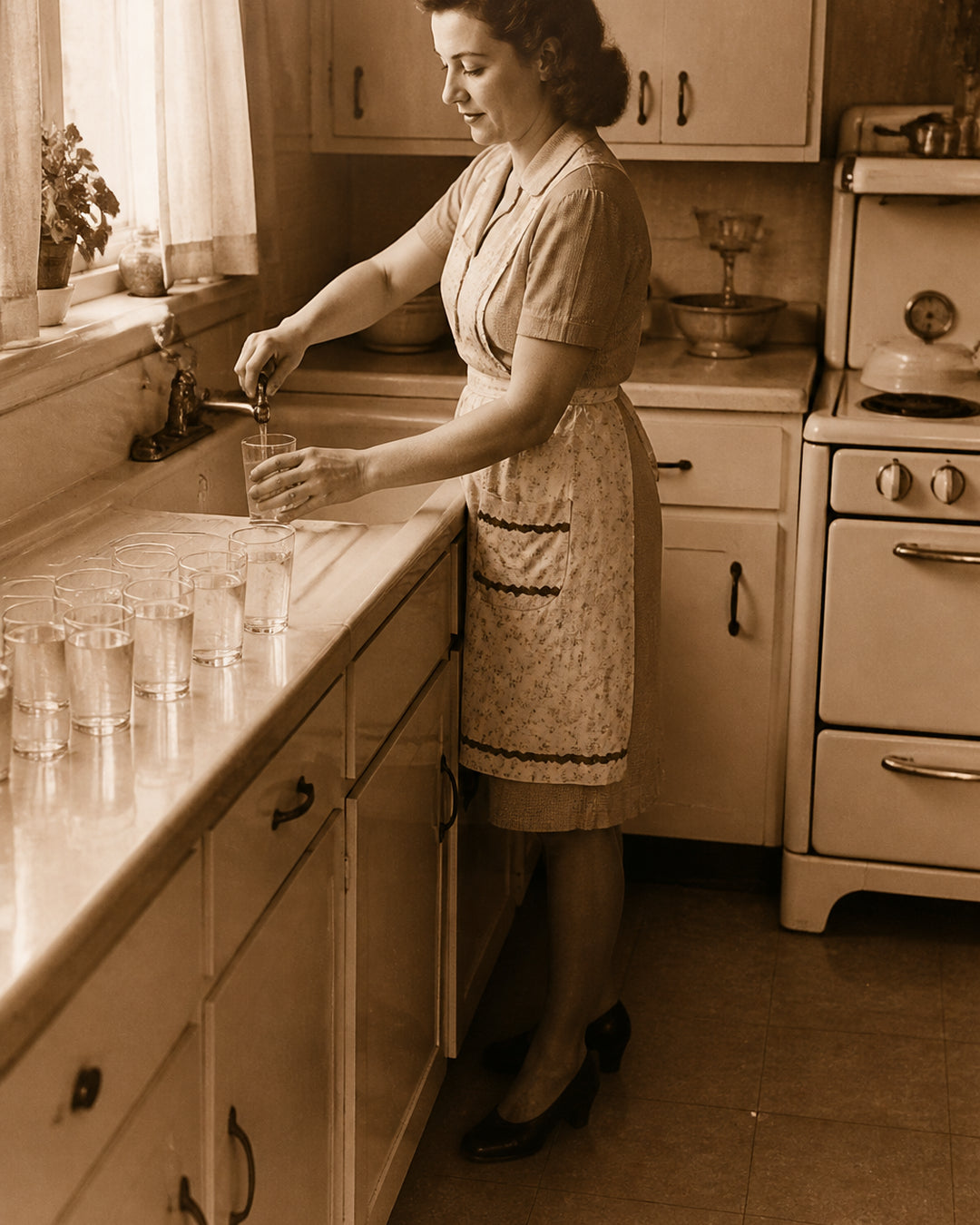
In 1945 the Food and Nutrition Board of the U.S. National Research Council published its recommendation for how much water an adult should take in. Few people have read the full passage in its original form:
“A suitable allowance of water for adults is 2.5 liters daily in most instances. An ordinary standard for diverse persons is 1 milliliter for each calorie of food. Most of this quantity is contained in prepared foods.”
Two and a half liters works out to about eight to eight and a half glasses. That is where “eight glasses a day” came from, the rule my mother repeated to me and I repeated to my own children.
Read the last sentence again, though. “Most of this quantity is contained in prepared foods.”
The board was counting the water in your soup, your oatmeal, your peaches, your morning coffee. It described total intake, food and drink together.
Somewhere between 1945 and the refrigerator magnets of my childhood, that final sentence fell off the end. A total-intake figure became a drinking-only quota.
In 2002, a kidney physiologist named Heinz Valtin went looking for the science behind the rule. His review in the American Journal of Physiology found no scientific evidence supporting eight-by-eight as a universal requirement, and he traced the whole thing to that 1945 passage and its vanished last line.
So for eighty years, the official advice concerned itself with one question: how many glasses to count, log, and haul around in the big bottle.
In all that time, nobody printed the other question on a refrigerator magnet, the one my mother had been asking at her sink since 1961. What is in the glass?
The Long Way Through Rock
What I learned about her well starts underground.
Water that comes from the ground has taken the long way. Hydrologists at the U.S. Geological Survey describe how groundwater moves through rock and sediment over years and decades, dissolving minerals as it goes: calcium, magnesium, and a long tail of trace elements.
The longer water sits in an aquifer, the more of the ground it picks up. That is why well water and spring water taste like something. The taste my mother spent sixty years missing was dissolved rock.
City water can be a different story, and I have to be careful here, because it is not the same story everywhere.
Nearly half of America's drinking water starts as groundwater, and some city taps run hard and mineral-rich. But many systems draw from rivers and reservoirs, where the water has spent days in contact with stone rather than decades.
And many utilities that do start with hard groundwater run it through lime softening, a process that uses calcium hydroxide to pull the calcium and magnesium back out on purpose, because hard water scales up pipes and water heaters.
Softening solves a problem for the pipes. Utilities adjust water chemistry to protect infrastructure and meet safety standards, and they do that job well.
Restoring the mineral profile of a Missouri farm well was never on the work order. So a surface-sourced or softened municipal supply can carry far less dissolved mineral than the water my mother grew up on, while looking identical in the jelly jar.
When I read that, sitting at my kitchen table in February, I put down my pen and called her. I told her the water in town had less of the ground in it than her father's well.
She was quiet for a moment. Then she said, “I have been telling you that since you were six.”
The Uninvited Passengers
There is a second half to what I found, and it sits less comfortably.
The water leaving a treatment plant is tested and regulated. But between the plant and your glass lie miles of mains, a service line that may date to whenever your street went in, and the plumbing inside your own walls.
Older lines and fixtures can shed traces of metal into water as it passes. That is part of why utilities manage water chemistry to keep pipes from corroding, and why replacing the oldest service lines has become a national project.
Hold those two findings side by side. On the way from the ground to your town, some of the dissolved minerals that gave water its taste and character were taken out on purpose.
And on the last mile to your kitchen, old pipes can shed traces of things water was never meant to carry.
My mother was right about her water for sixty years, and everyone told her it was nostalgia. That bothered me enough to keep reading, and the reading is how I found the two drops.
The Magnet and the Minerals
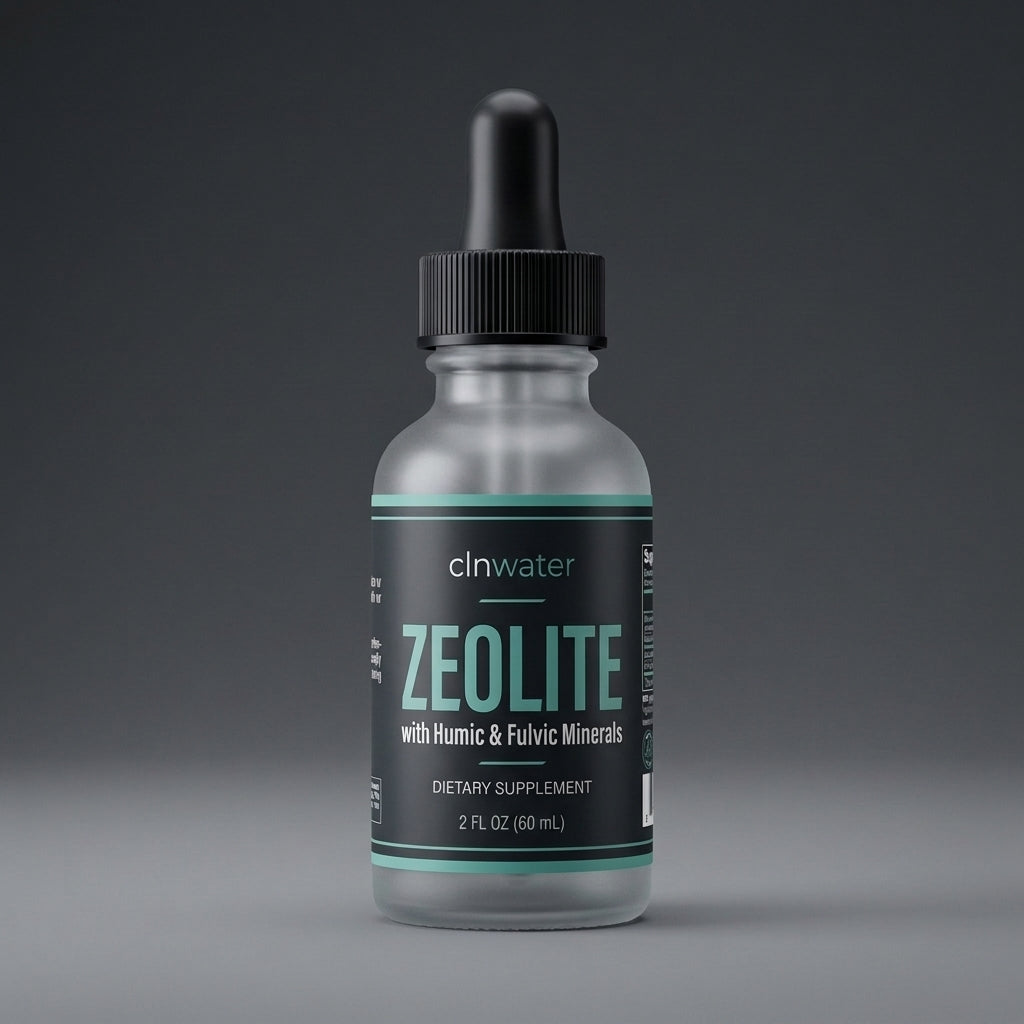
The bottle is called Trace: Zeolite with Humic & Fulvic Mineral Drops, made by a small water company called clnwater. I came across it while reading about zeolite, a volcanic mineral I had never heard of before this winter.
What caught my attention was that the formula matched both halves of the problem I had spent months documenting. The company calls those halves the Magnet and the Minerals.
the Magnet and the Minerals
Treated water arrives clean, mineral-empty, and carrying whatever the last mile of pipe added.
Natural zeolite, a microscopic cage, attracts and holds certain positively charged ions through cation exchange.
Humic and fulvic acids carry the trace elements stripped water lost, back in drink-ready ionic form.
The Magnet is natural zeolite. Under a microscope, zeolite looks like a honeycomb of tiny cages, and its framework carries a net negative surface charge.
Positively charged ions are drawn to that charge and held inside the cages. Chemists call this cation exchange, and it is the property that has made zeolite a workhorse of water treatment for decades. In your glass, that binding happens in the minute between pouring and drinking.
The Minerals are humic and fulvic acids, dark plant-derived compounds that carry trace elements. This is the half my mother's sentence was about.
Humic and fulvic acids hold minerals in ionic form, the drink-ready form, dissolved the same way minerals end up in water that has taken the long way through rock. Two drops carry a version of what the treatment plant was never asked to put back.
One dropper does both jobs in the same glass. The zeolite attracts and holds certain positively charged ions, and the humic and fulvic minerals restore a measure of what the ground used to supply.
There is a side effect, and I noticed it before I understood the chemistry. The water tastes different, and rounder is the best word I have found for it.
The First Two Weeks
The routine could not be plainer. Two drops in a glass of water, or scale it up once for a pitcher in the refrigerator.
The drops disperse on their own, and a quick stir finishes the job. There is no schedule to keep beyond the water you were going to drink anyway, which, if you follow the 1945 board's advice in its full and honest form, includes what is on your plate.
What should you expect at first? Taste is the first thing most people notice: the water feels fuller in the mouth within the first few glasses, closer to spring water than to the flat tap my mother complained about for sixty years.
Past that, there is nothing to watch. The zeolite holds ions in its cages, and the humic and fulvic acids carry minerals in a form water can hold. Trace supports normal hydration and everyday mineral intake, and that is the full extent of the promise.
I mailed a bottle to my mother in March. She used it in the jelly jar, because of course she did.
She called two days later and skipped hello. She said, “It tastes like something.”
What 1945 Got Right
I have thought all spring about those two announcements, made in the same year, by people who never imagined my mother's windowsill.
The advice was never wrong. Drink your water, take in about two and a half liters a day counting what is in your food, and you are doing what the 1945 board asked of you. Eighty years of counting glasses did no harm.
The advice was silent on one question, though, and the engineers were too busy to raise it. What should the water carry?
Grand Rapids proved a city could design its water at the plant. Nobody in 1945 stopped to itemize what the finished recipe would leave out, or what the pipes would add on the way to the sink.
My mother's jelly jar sat on that windowsill through the whole experiment, and she graded every glass. It is still there after fifty years, and she likes her water again.
If her sentence sounds like one you have said about your own tap, you can read what is in the bottle, the zeolite, the humic and fulvic minerals, and the sourcing, on the clnwater page for Trace. See what's in Trace, and decide whether your glass has been missing the same thing hers was.
What I tried before the drops
Once I understood what my mother's glass had lost, I went shopping for a way to put it back. I tried three things before the drops, and each one taught me something.
It works, and it is the expensive way to prove the point. A case a week at the store, call it twelve dollars, runs past six hundred a year. My mother drinks most of her water standing at the kitchen sink, and nobody her age wants to haul a case of bottles up the stairs every week.
Cost: roughly $600 a year, plus the plastic · Felt like: renting the answerPeople online swear by it. Salt covers sodium and nothing past that. The range of trace elements her well carried is a longer list than one shaker holds, and her doctor already watches her sodium.
Cost: pennies · Felt like: guessingAn add-back stage for the pitcher. It doses a token amount, fades within weeks, and matches nobody's water in particular. The idea was right, but the delivery was thin.
Cost: cartridge after cartridge · Felt like: half a fixEach try ran into the same two-part problem. Putting the good back in was only half the job, because whatever had come in through the pipes was still in the glass.
| Bottled mineral | Salt pinch | Add-back cartridge | Trace drops | |
|---|---|---|---|---|
| Puts trace minerals back | Some brands | Sodium only | A token dose | ✓ the full range |
| Binds heavy metals in the glass | ✗ | ✗ | ✗ | ✓ the Magnet |
| Works with any water | Its own water | ✓ | One pitcher | ✓ tap, filtered, or well |
| Daily effort | Carry cases | Guess amounts | Install, replace | A few drops |
One bottle covers all three
The dropper lives wherever the water gets poured. Most houses land on these.
The jelly-jar test. A few drops in the water already being poured all day.
Coffee is mostly water. Fix the water and the morning cup comes along.
Dose the refrigerator pitcher once and every glass poured from it is done.
What to expect, and when
A few drops per glass or pitcher; the label gives the exact count. From there, this is the honest shape of the first month. Everyone runs on their own clock.
Questions I had, answered straight
What is in Trace?
Two working parts in a purified water base. The first is natural zeolite (clinoptilolite), a volcanic mineral whose caged structure attracts and holds positively charged ions in your glass through cation exchange. The second is humic and fulvic acids, plant-derived carriers that hold trace minerals in ionic, drink-ready form. Full sourcing details are on the product page.
How do I use it?
Two drops per glass of water, stir once, drink as usual. For a household, add drops to a pitcher in the refrigerator at the same ratio and pour from that through the day. Use it with the water you already drink.
Does it change the taste?
The drops carry little taste of their own. What most people notice is the water itself: rounder and fuller, closer to spring water than to a flat treated tap. If your water has tasted like nothing for years, taste is where most people notice a difference first.
Is it tested?
Yes. Trace is produced in small lots, and each lot is tested for purity and consistency before it ships. The zeolite we use is natural clinoptilolite, a mineral with a long track record in water treatment.
What about my filter? Do I still need it?
Keep it. A filter and Trace do different jobs. The filter takes things out of the water before it reaches your glass. Trace works after that point: the zeolite binds certain positively charged ions right in the glass, and the humic and fulvic minerals add back trace elements that treated water often lacks. Add the drops after filtering, in the glass or the pitcher.
What readers are saying


clnwater is a small company. If this page is up, Trace is in stock, and that is the whole availability story.
Two ways to pour the next glass
Keep the 1945 advice, minus its missing sentence, for another decade. The water stays clean and stays empty, and nobody notices, because nothing about the glass looks different.
Read what is in the drops, decide for yourself, and give the water back the part the well always gave it.
P.S. The taste question comes up first. Mineral water tastes like something, and rounder is the word my mother uses. If a glass has tasted flat for years, that is the first change to expect.
P.P.S. Trace does two narrow jobs in the glass: the zeolite binds certain positively charged ions, and the minerals carry in trace elements the water can hold. Anything promising more than that deserves the eye-roll my mother gave the salt trick.
To the well-water generation, and everyone downstream of it,
Ellen Marsh