
This week's cartridge batch is moving fast. The clnwater Halo shower head is available today.
You've changed every shampoo. The thing wrecking your hair turns on every morning when you shower.
The masks, the bond-builders, the $40 shampoo your stylist swore by. None of it held, and you started to believe it was just your genes or your age. There's one variable you never changed, and it runs over your scalp hot for ten minutes a day.
 Erin WalshBeauty & haircare contributor
Look at the drain after you wash your hair. Look at the brush. If the amount coming out has crept up over the last year, and your hair feels drier, frizzier, thinner than it used to no matter what you buy, you've probably already decided it's hormones, or stress, or just getting older. Before you accept that, there's one thing in your bathroom you've never once suspected, and it touches every strand on your head every single day.
Here is the pattern almost nobody connects. You buy the better shampoo, and for a week it seems to help. Then it stops. So you blame that product and buy the next one, and the cycle repeats until your shower shelf is a graveyard of half-empty bottles and you've quietly concluded your hair is just like this now. That cycle is the tell. When every product fails the same way, the problem usually isn't the products. It's something doing the opposite of what they do, every morning, faster than they can work.

I tried switching shampoos, conditioners, hair masks. Nothing really helped. Turns out it wasn't my products, it was the water.Verbatim, r/curlyhair
Does any of this sound like your hair?
- Drier, frizzier, more brittle than it was a couple of years ago, no matter the routine
- More in the drain and the brush than there used to be
- A new shampoo "works" for a week, then stops, every time
- Color fades or goes brassy fast, days after you leave the salon
- Your hair is visibly better whenever you travel or stay somewhere else
- A stylist or dermatologist once asked if you have hard water or a filter
Three or more, and you're not looking at a product problem. You're looking at a water problem.
Maya, thirty-four, spent two years and a small fortune chasing it. Olaplex, a keratin treatment, biotin, a scalp serum, the $200 shampoo her colorist swore by. Her hair kept thinning and frizzing anyway. Then she spent a week at her sister's place across the state and her hair behaved like it was ten years younger. Same products. Different water. That was the moment the whole thing flipped for her.

The Hot-Water Gap: why your shower is the worst water your hair meets.
Your tap water carries chlorine, added by the city to keep it safe on the way to you. In a cold glass that's barely noticeable. In a hot shower it's a different story, and the difference has a name we'll use the whole way through: the Hot-Water Gap. Heat does two things at once. It opens the cuticle, the shingled outer layer of every strand, so whatever is in the water gets in instead of running off. And it drives the chlorine to react harder, stripping the natural oils that keep hair flexible and oxidizing the strand from the outside in. Ten minutes a day, every day, on hair you're simultaneously paying to repair.
Some cities run chloramine, chlorine bonded to ammonia, which is even more stubborn and lingers longer. Either way, the result on your hair is the same: roughened cuticle, lost moisture, color that won't hold. One thread in a hair-loss forum put it bluntly after testing their own tap: the chlorine in their water read higher than the chlorine in their swimming pool. You would never wash your hair in pool water on purpose. Most people do a milder version of it every morning without knowing.

The cuticle is the whole game.
Healthy hair lies flat and smooth, so it reflects light and holds moisture. Heat and chlorine lift and roughen that outer layer. Lifted cuticle is what you feel as frizz, see as dullness, and fight with every serum you own.
The serum smooths it for a few hours. The next hot shower lifts it again. That is the loop you've been stuck in, and no bottle on the shelf was ever going to win it.
The water doesn't smell like a pool anymore and my skin doesn't feel dry anymore, and my eyes don't hurt anymore either.A common before-and-after, posted in r/eczema
And here's the part that turns a daily annoyance into a slow loss. This isn't one bad shower. It's the same hot, chlorinated water, on hair you're trying to grow and protect, every morning, for years. There is no neutral setting. Hair is either recovering or being re-stripped, and right now, ten minutes a day, it's being re-stripped on a schedule. The shed in the drain and the frizz that won't quit aren't random. They're the running total of a thing you do every single day without ever choosing it.
You weren't failing. You were being undone every morning.
This is the part that takes the blame off you, where it belongs. Every product you tried works on the strand. The water works against the strand. And the water gets the first and last word of every single day, in heat, with the cuticle wide open. You were not doing it wrong. You were bailing a boat with a hole in it.
Why each fix kept failing.
So the fix was never going to come from another product applied to the strand. It had to come from changing the water before it ever reaches your hair. Not softer water, not a gentler soap. Water with the chlorine taken out of it, at temperature, at shower speed. That turns out to be a specific and slightly unobvious piece of chemistry, and it's where most shower filters quietly fail.
The loop you're in
- Buy the product, get a week of "better"
- Hot shower re-strips it the next morning
- Blame the product, buy the next one
- Shelf fills with half-empty bottles
- Conclude your hair is "just like this now"
The loop you want
- Change the water once, at the shower head
- Every product finally gets to do its job
- Nothing re-strips the strand each morning
- One cartridge instead of a shelf of fixes
- Hair recovers under protection, not attack
The Galvanic Core: the one stage that actually works in hot water.
Here's the catch that sinks the cheap shower filters. The usual filter media is activated carbon, and carbon removes chlorine by adsorption, a physical bond that depends on cool water and time. A shower is the opposite of both: it's hot, and the water races through in a couple of seconds. Hot water doesn't just weaken carbon, it can make carbon release what it already grabbed. So the $20 carbon shower head tests fine for a week or two, then quietly stops doing much, in exactly the hot water you actually shower in.
The Halo leads with a different stage, and clnwater named it because it's the reason the thing works: the Galvanic Core. It's a bed of high-purity copper and zinc, called KDF-55. The two metals sitting in water form millions of tiny galvanic cells, and when chlorine hits them it isn't adsorbed, it's chemically converted, reduced to harmless chloride, the same ion in a pinch of table salt. That reaction is near-instant and, crucially, it does not care about temperature. It works just as well in a hot shower as a cold one, and it works at the speed water actually moves through a shower head. Carbon still rides along after it as a polishing stage for byproducts and the pool smell, but the Galvanic Core is the stage doing the heavy lifting that carbon alone can't.
You've seen the $20 heads and the $300 systems. Here's where Halo sits.
| The $20 carbon head | The $300+ subscription system | Halo | |
|---|---|---|---|
| Removes chlorine in HOT water | Fades fast, carbon hates heat | Usually yes | Yes, the Galvanic Core |
| Holds up at shower flow rate | Too little contact time | Yes | Near-instant reaction |
| Full water pressure | Varies | Some report a drop | Engineered for full flow |
| Honest about hard water | Often implies "softening" | Sometimes overclaims | Does not soften, and says so |
| What it costs you long-term | Cheap, replace constantly | Locked subscription, ~$890 over 5 yrs reported | ~90-day cartridge, no lock-in |
The Worn-Cartridge Test: the proof that it wasn't placebo.
Skeptics are right to be skeptical of shower filters, because the aisle is full of junk. So here's the proof that convinced the doubters, and it's not a testimonial, it's a pattern they noticed by accident. People switch to a filtered head, their hair and skin get better over a few weeks, and then they forget to change the cartridge. As it wears out, the dryness and the frizz creep back. They change it, and within a week things improve again. That on-off pattern is the Worn-Cartridge Test, and a placebo doesn't switch itself off when a cartridge expires and back on when you replace it. One person summed it up: "I know it's not placebo because as the cartridge wore out my legs started getting dry and itchy again."
There's a cost to leaving it, and it isn't only your hair. Every month you spend fighting the water with products is a month of money going into bottles that get undone by tomorrow's shower, while the damage to the strand keeps compounding. A stylist on one forum put the math plainly: the people she sees with the worst breakage are rarely using bad products, they're showering in water that's quietly working against good ones. The longer the strand takes the daily hit, the more there is to recover from once you finally stop it.
Bought a shower head with a filter and my hair has come back to life. I genuinely didn't believe it would do anything.Verbatim, r/curlyhair
The Halo Filtering Shower Head.
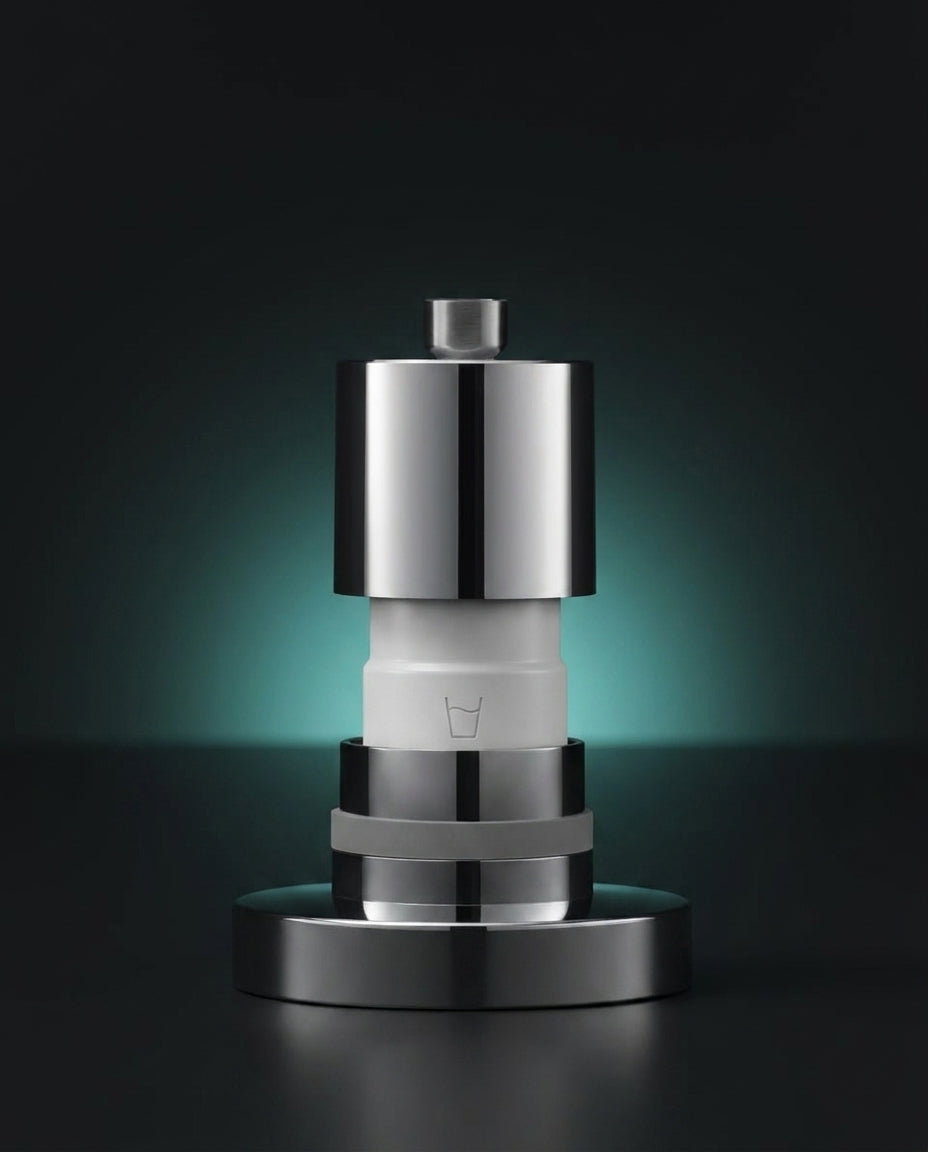
A small Utah operation that built the head around the stage that actually survives a hot shower, instead of the cheapest media that photographs well on a box.
- The Galvanic Core (KDF-55): copper-zinc that converts chlorine to harmless chloride, at temperature and at shower speed, where carbon fades.
- A six-stage build: sediment, the Galvanic Core, activated coconut carbon to polish byproducts and the pool smell, then polishing mesh for full flow.
- Engineered for full pressure: the face is built for real flow, not the sad trickle cheap filtered heads are known for.
- On your schedule: a roughly 90-day cartridge, no subscription you have to fight to cancel.
The order it tends to happen in.
The water stops smelling like a pool. Most people notice this one immediately, and it's the first sign the chlorine load is actually down.
Skin stops feeling tight after you towel off. The itch on the legs and arms eases. This shows up before the hair does.
Hair starts feeling softer and less straw-like. Less frizz on the same routine. Color holds a little longer between salon visits.
The bigger change: texture and shine come back, shedding settles, and people start asking what you changed. Hair grows out under protection instead of under attack.
Results vary with your local water and your hair. The honest version: removing the chlorine stops the daily damage, it doesn't regrow hair you've already lost or replace a medical treatment for hair loss.
What a skeptic actually asks.
Isn't this just placebo? It's a shower head.
Fair, and most of them are. The reason this one isn't comes down to the Worn-Cartridge Test: the benefit fades as the cartridge expires and returns when you replace it. Placebo doesn't run on a 90-day chemical clock. And the mechanism is real chemistry, not a vibe, the copper-zinc reduces chlorine whether you believe in it or not.
Will it soften my hard water?
No, and any shower head that claims it will is lying to you. Softening removes calcium and magnesium and takes a different system entirely. The Halo takes out chlorine and helps reduce chloramine, which is the part oxidizing and drying your hair. Hard-water minerals are a separate issue, and we won't pretend a shower head fixes them.
Won't a filter kill my water pressure?
It's the common complaint about cheap filtered heads, and it's a real failure of cheap hardware, not of filtering. The Halo's face is engineered for full flow. You get filtered water at a normal, satisfying pressure, not a filtered trickle.
Every filter brand overclaims. Why trust yours?
You shouldn't trust the adjectives, ours or anyone's. So here's the honest scope, including the limits: it reduces chlorine, helps reduce chloramine, and reduces some heavy metals, it does not soften hard water, and the cartridge wears out in about 90 days and needs replacing. A brand that tells you what it can't do is usually more reliable about what it can.
I already have a filter on my drinking water. Doesn't that cover it?
Different water, different problem. A drinking filter treats the cold water you swallow. Your hair and skin take their daily hit from the hot water in the shower, which most homes don't filter at all, and which is the worst-case scenario for chlorine because heat drives the reaction and opens the cuticle. The shower is the unguarded tap, and it's the one touching every strand on your head every morning.
Is it a hassle to install?
No tools, no plumber. It threads onto the same arm your current shower head sits on, by hand, in about two minutes. You swap the cartridge roughly every 90 days the same way. That's the entire maintenance.
What if my hair doesn't change?
Then it costs you nothing. Run it 60 days. If your hair and skin don't feel different and the pool smell doesn't disappear, send it back for every dollar. The risk sits with clnwater, not with you. Worst case, you showered in cleaner water for two months and got a full refund.
Stop repairing hair that's being re-damaged every morning.
The Halo Filtering Shower Head, built on the Galvanic Core so it actually works in a hot shower. Softer hair and skin from the same routine you already do, because the water finally stops working against you.
If you've read this far, you already half-knew. The products were never the problem, and they were never going to be the fix. The water that touches your hair before and after every product you own is the one thing you never controlled. This is where you take it back.
P.S. The fastest gut-check costs nothing. Next time you shower somewhere else, a hotel, a relative's place, notice your hair the next morning. If it behaves better on someone else's water, you just ran the experiment, and the variable was never your shampoo.
This is a sponsored advertisement for the clnwater Halo Filtering Shower Head. "The Hot-Water Gap," "the Galvanic Core," and "the Worn-Cartridge Test" are clnwater's plain-language names for how chlorine behaves in hot shower water, how a copper-zinc (KDF-55) stage reduces it, and the at-home pattern owners use to confirm it. They describe product design and everyday observation, not laboratory certifications.
The Halo reduces chlorine, helps reduce chloramine, and reduces certain heavy metals in shower water. It does not soften hard water and is not a medical device; it does not treat, cure, or prevent hair loss or any condition. Results vary with local water quality and individual hair, and depend on replacing the cartridge as directed. Competitor pricing referenced reflects publicly reported figures and is illustrative.
Guarantee terms and shipping details available at checkout. clnwater. Cedar Hills, Utah.